modular | nº 2
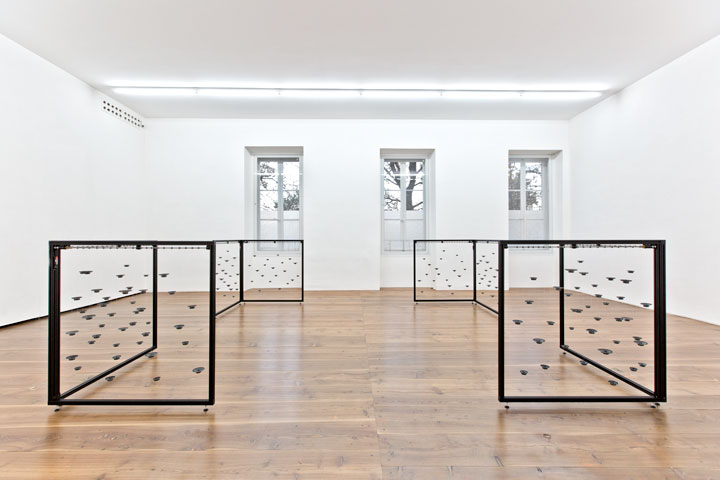
modular | n°2 – speaking of membranes is a sound sculpture that consists of several miniature speakers acoustically activated by a motor driven frictional mechanism.
Marianthi Papalexandri-Alexandri & Pe Lang
Commissioned by the SWR -Donaueschingen Musiktage
Supported by the International Artist House Villa Concordia
Exhibition at Museum Art Plus Donaueschingen
Materials: actuator, metal, nylon, miniature loud speakers,rosin
Image: Pe Lang
Year: 2017
VIDEO
Sound Sculpture I, II, III
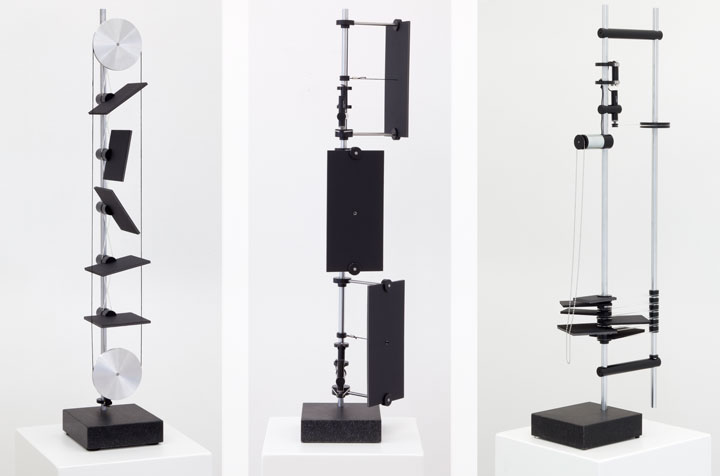
The three kinetic sound sculptures control and put physical forces in action with a captivating elegance. The work combine precise self- made mechanical systems with motors, rosined plastic wheels, cotton threads, steel, metal chain, lightweight foam board, granite and rubber. The sounds produced when certain structures come in contact with each other, different tones of clicks and ticks mechanically programmed and generated by the slow moving rosined wheel gradually eroded, and a metal chain starts to ‘dance’ in a captivating and fascinating manner.
In colaboration with Pe Lang
Materials: motors, batteries, cotton, foam board, granite, stainless steel, polyacetal, mechanic
Image: Anhava
Year: 2015
VIDEO
Solo for Motor, Serpent and Brain Model
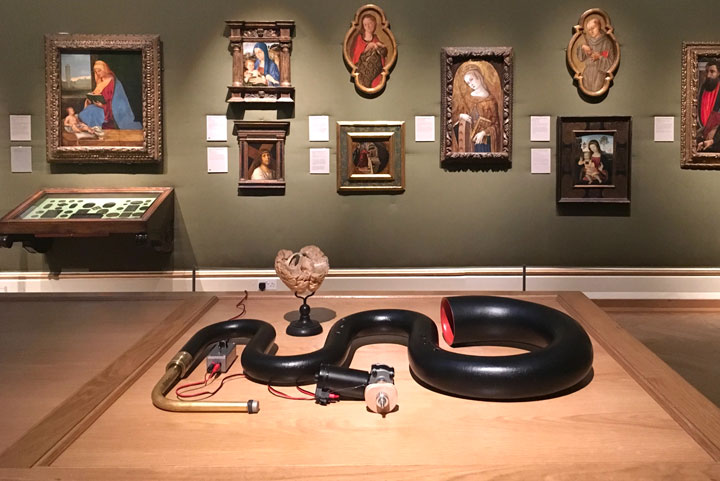
Sound Installation, Asmolean Museum -Supersonic Event with the support of Oxford University Bate Collection of Music Instruments and the Department of Physiology Anatomy and Genetics.
Materials: motor, serpent, silicone, nylon, wood, rosin, aluminum
Image: Papalexandri
Year: 2017
Solo for Motors and Strings
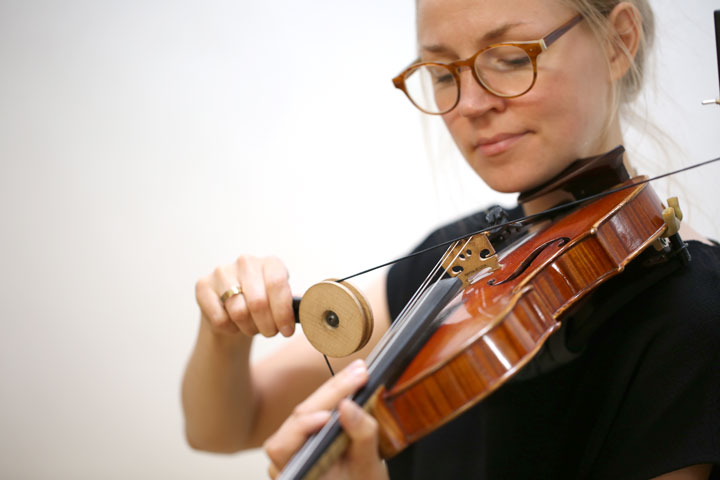
Commissioned by Ultima Festival 2016 with the support of Ernst Von Siemens Music Foundation
Materials: motors, violin, foam board, silicone, thread, elastic cord, metal clip, wooden wheels, rosin
Written for Karin Hellqvist
Concept: Papalexandri
Year: 2016
Sound devices created by Papalexandri and Pe Lang
Image: Pe Lang
Duo for Motor and Sound Panels
Composition Commissioned by Hidden Mother with the support of the Swedish Arts Council
Written for Hidden Mother: Magdalena Meitzner and Ulrik Nilsson.
Concept/artistic direction/choreography: Marianthi Papalexandri
Materials: motor, violin, foam board, silicone, thread, elastic cord, stainless steel, metal clip, wooden wheels, rosin
Year: 2016
Image: Pe Lang
Speaking of Membranes
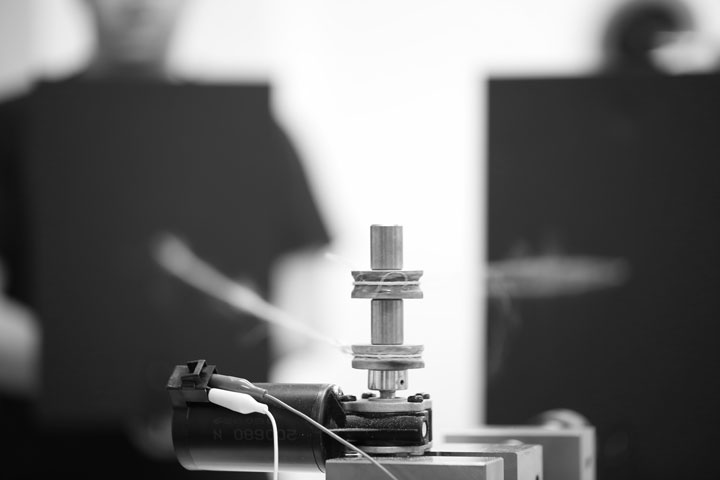
Speaking of membranes is a sound sculpture that consists of several miniature speakers acoustically activated by a motor driven mechanism. A nylon thread is fastened through a hole at the center of the membrane; the end of the nylon thread is loosely secured to a motor turned rosined wheel to produce friction. Sound is produced by the action of the rim of the rotating wheel rubbing the thread as the wheel is turned. The two surfaces alternating between sticking to each other and sliding over each other, with a corresponding change in the force of friction. The motor speed is reduced at the lowest speed. The slow turn of the wheel creates changes in the tension of the thread, resulting as sounds (crackling impulse) in the membrane of the speaker.
©Marianthi Papalexandri-Alexandri / Pe Lang
Materials: actuator, metal, nylon, speakers
Size: 200 x 200 x 200 cm
Le Bon Accueil, Montfort, France
Image: Pe Lang
Year: 2014
Video courtesy of the artist
Untitled V
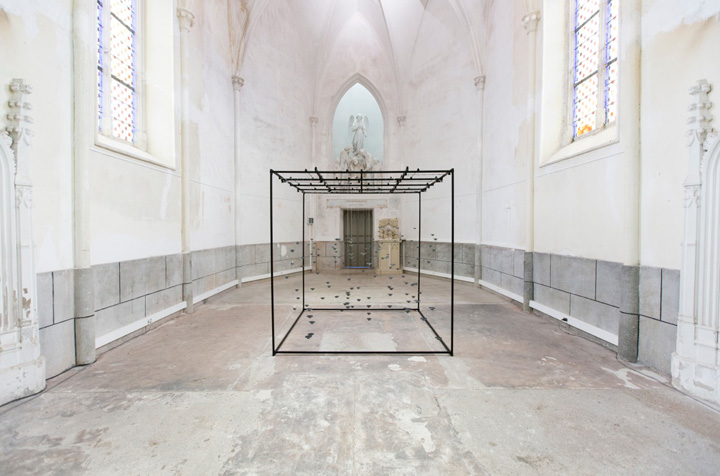
Untitled V is a sound sculpture that consists of miniature speakers acoustically activated by a motor driven mechanism. A nylon thread is fastened through a hole at the center of the membrane; the end of the nylon thread is loosely secured to a motor turned rosined wheel to produce friction. Sound is produced by the action of the rim of the rotating wheel rubbing the thread as the wheel is turned. The two surfaces alternating between sticking to each other and sliding over each other, with a corresponding change in the force of friction. The motor speed is reduced at the lowest speed. The slow turn of the wheel creates changes in the tension of the thread, resulting as sounds (crackling impulse) in the membrane of the speaker. Untitled V creates a very quiet listening experience.
©Marianthi Papalexandri-Alexandri / Pe Lang
Materials: actuator, metal, nylon, speakers
Size: 600 x 250 mm
17th Japan Media Arts Festival ( Jury Selection )
Tone Standing Pine Gallery, Nagoya, Japan August 2013
Image: Pe Lang
Year: 2013
Video courtesy of the artist
chesSound
solo for prepared chess written for Grandmaster Vera Nebolsina.
concept, composition & direction : Marianthi Papalexandri Alexandri
performer : Vera Nebolsina
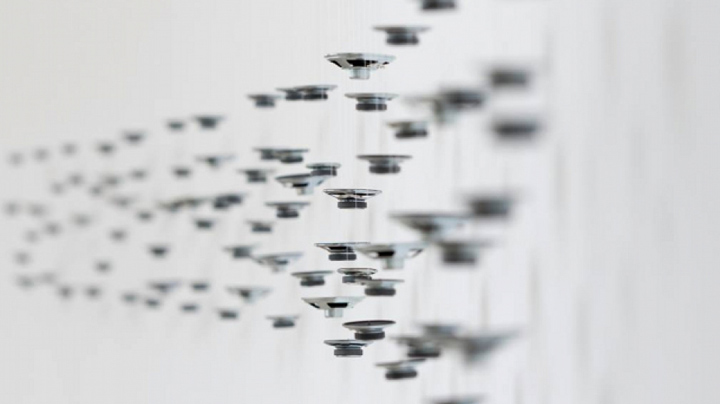
chesSound solo for prepared chess was developed in collaboration with Nebolsina and Hirakawa.The work creates an interactive dialogue between chess, sound and image. Preparation introduces structural and functional possibilities by; defining musical sections; affecting the form of playing; alerting the habitual perceptions of the performer as well as determining speed, dynamics and other musical parameters. Particularly the work examines the same slow repetitive physical gestures under different conditions. By questioning the function of gestures and sounds chesSound invites both the performer and listener into an evocative private sound-visual world as well as to new ways of engaging to chess and music, acoustically and visually. This work can be presented both in the form of a video work and live performance.
The video operates both as a self-reflexive and compositional tool that facilitates extending the physical limits and possibilities of the performing body. It provides the possibility of exposing the detailed movements and gestures of making the sounds that come along with the detailed movements audible and traceable.
Kindly supported by Akademie Schloss Solitude
First performance Akademie Schloss Solitude: Drawing pieces: an encounter between art and chess
video: Youki Hirakawa
Year: 2014
Sound Object I
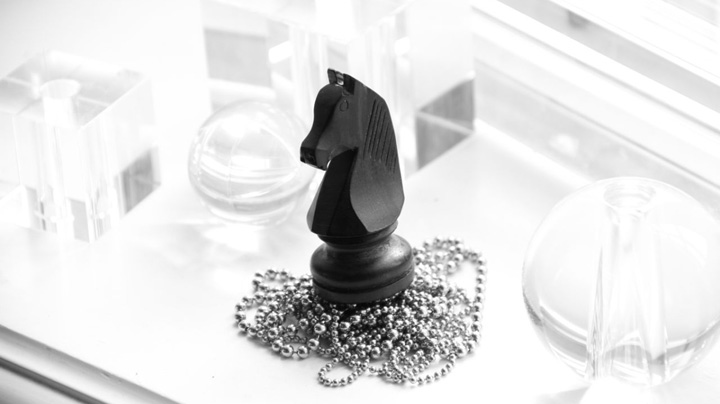
Materials: aluminum, wood, glass, mechanical parts, motor
Exhibition TONEplant; CASE02: Pe Lang / Marianthi Papalexandri-Alexandri
10-31 August at Standing Pine Gallery, Nagoya, Japan
Image courtesy of the artist
Size: 1000 x 350 x 350mm
Year : 2013
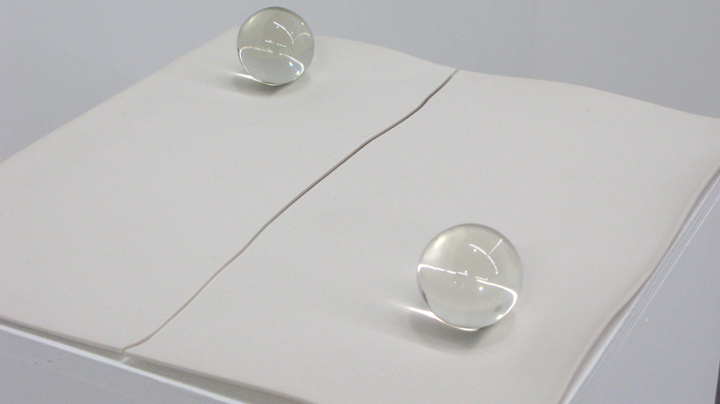
Quartet for Motors and Resonant Bodies
Quartet for Motors and Resonant Bodies combines acoustic instruments (resonant bodies) and motor driven devices that function both as sound sources themselves and as active preparations that determine speed, dynamics and other musical parameters. The result is a slow, purposeful "unfolding" of sound: an intense procedural sequence of extremely minimal slow-motion movements produces complex and concentrated sustained sounds and textures over time.
Commissioned by Yarn/Wire. Premiered at Issue Project Room, New York.
Materials : motors, elastic cord, drum heads, piano, sand paper, wood, bead chain, cardboard, log drums
Image: Yarn/Wire
Year: 2013
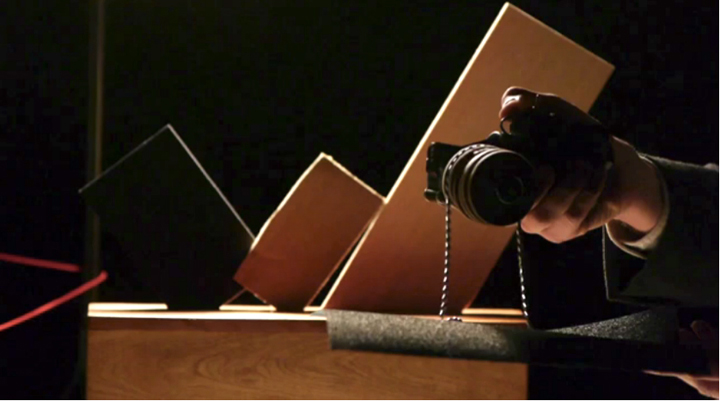
Untitled VI
for three male voices, sound objects and motors
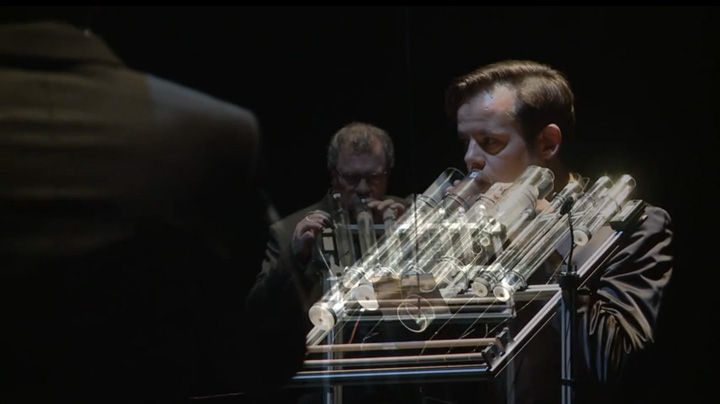
In Untitled VI the vocalists are singing with modified resonant tubes and motors the Greek word "akousate," which means to listen attentively. What happens when voice and singing are mediated and controlled with motor driven resonant bodies? How does this act of singing change the physical and imagined presence of the voice? How does it affect the process of intensive listening to one's own voice, to one another, and to external sounds? Exploring these questions, Papalexandri encourages hearing the resonances between different voices and bodies.
text : Zeynep Bulut
Commissioned by the Neue Vocalsolisten Stuttgart to be premiered at ECLAT Festival Neue Musik festival, Stuttgart. Mediterranean Voices Project. Premiered by Andreas Fisher, Martin Nagy and Daniel Gloger.
Materials: motors, aluminum, elastic, membrane, nylon, wood, sand paper
Image courtesy of the artist
Year: 2013 -2014
Extensions
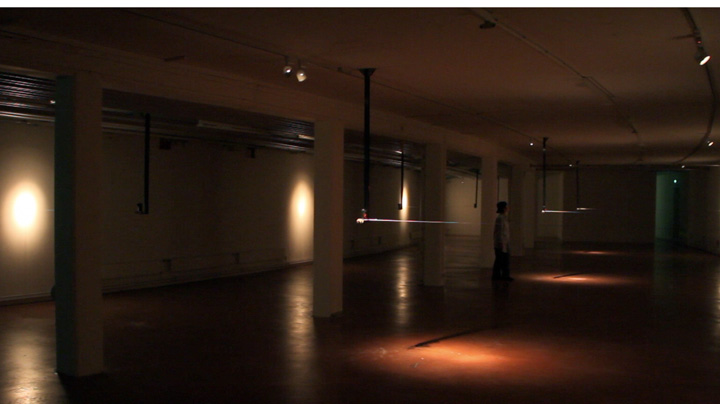
Sounds are entangled. They come from and travel around a variety of bodies. Continuous and liquid, sounds do not necessarily arrive at presumed destinations. Embodied and imagined, their physical and imaginary connotations are intimately different. Even if sounds are habituated within the material culture of hearing and listening, they remain contingent, as they also mingle with one another. Sounds simultaneously change and are changed by their immediate physical environment. Such contingency can potentially draw our attention to what gets unnoticed, unseen and unheard.
Marianthi Papalexandri-Alexandri's Extensions realizes this potential, while marking the inaudible sounds in an invisible space. Installed in the "Unterer Hirschgang" the work points at seven locations. In each location, a steel wire that is connected to a special mechanical device acoustically activates an invisible surface. This configuration invites us to attentively hear and see the production of sound, the movement of the wire between the surface and the mechanical device. The seven locations vibrate both individually and together. Their spectrum of frequencies become audible both in their own marked zone and in dialogue with one another. They together turn the "Unterer Hirschgang" into a sounding body. Extensions then awakens the "Unterer Hirschgang" to a resonant space. text: Dr. Zeynep Bulut
Site specific sound installation
Edition: Unique
Horch!/ Listen Academy Schlos Solitude (Unterer Hirschgang)June 14 - July 29 Group Exhibition
Kindly supported by Akademie Schloss Solitude
Image: Youki Hirakawa
Materials: wood, steel, motor, aluminum
Year: 2012
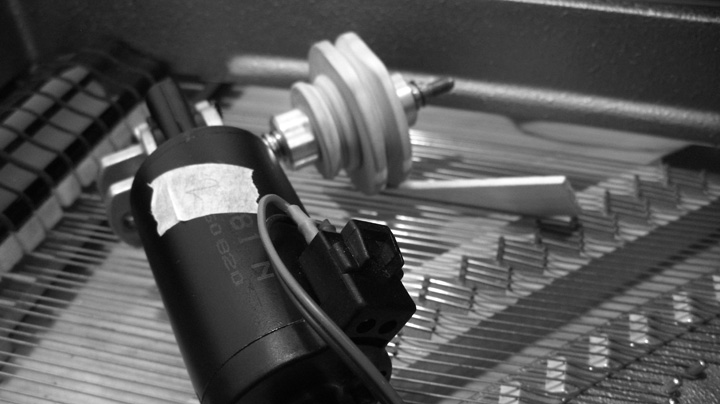
Solo for Motors and Resonant Body
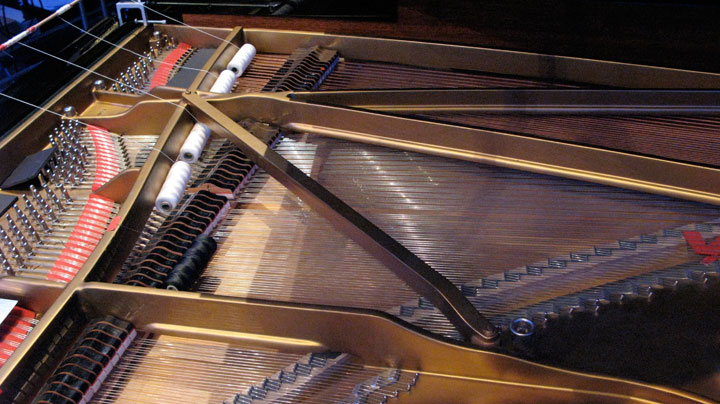
Solo for Motors and Resonant Body, is using motors prepared with a wooden wheel and placed on different locations inside the piano (on the strings, next to the nails, etc.) in such a way that it allow them to move, spin -- to behave in a way that is similar to a live organism, producing an enormous variety of rhythms and sounds. The wheels have been modified and shaped to produce different angles, such that they come into contact with the strings in a variety of ways. At the same time the sound of the engine is amplified by the body of the piano. The performer can influence the sound by changing or operating the speed controller, which changes the engine sound of the motor.
Commissioned by the x-tract production for the "faithful! Fidelity and Betrayal of Musical Interpretation" festival, Berlin. Premiered by Ernst Surberg. Kindly supported by Akademie Schloss Solitude and x-tract production.
Materials: motors, wood, piano, speed controllers
Year: 2012
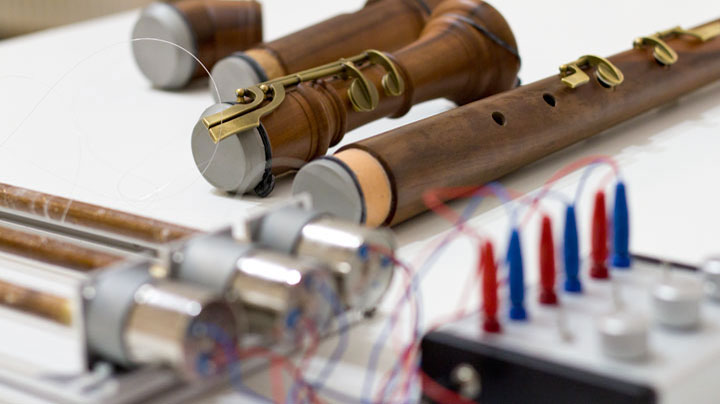
Untitled IV
Untitled IV (atemlos) is both a composition and installation work that consists of four prepared recorders (19 parts) with one end open and the other closed with an elastic silicone membrane. A nylon line is fastened through a hole at the centre of the membrane; the end of the nylon line is loosely secured to a wooden resined motor driven rod to produce friction. The sound is produced by the nylon line causing the membrane to vibrate by friction. The sound of Untitled II can be influenced by manipulating the tension of the nylon lines, changing the speed of the motor, turning on and off the motors, depressing the membrane with the fingers while it is vibrating to vary the pitch or by playing on the keys. The work is using the principle of the motor driven plexiglass rods construction developed for Untitled II (2010) as well as for Untitled III ( 2011).
Commissioned by QNG -quartet new generation-. Supported by Berliner Kompositionsstipendien 2011 and Academy Schloss Solitude.
Ultraschall Festival /Berlin Musical Instrument Museum.
Materials: 6 motors, 6 wooden robs, 2 metal frames, 2 power adapters, speed controllers, nylon line, elastic silicone membrane and 4 recorders.
Size: Variable
Year: 2011-2012
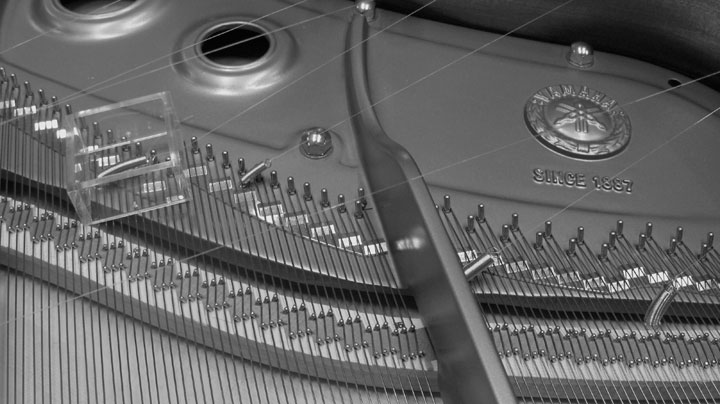
Untitled III
Untitled III, solo for prepared piano and sound devices, can be presented both as a sound installation and as an instrument in the context of a solo live performance. The work is using the principle of the motor driven plexiglass rods construction developed for Untitled II (2010). Instead of the plexiglass tubes(memphraphones) used for Untitled II the rods (prepared with rosin) are connected via fishing lines and metal spring clips to the piano strings, allowing the performer to activate the full range of the piano with one gesture. As an interface between the instrument and the performer, this device calls for a new form of behaviour.
Commissioned by MORF. Premiered by Frederik Croene at deSingel Antwerp.
Materials: 3 motors, 3 acrylic glass robs,4 acrylic glass frames, nylon line, metal springs clips, kappa, vibration motor device, and wheel device.
Size: Variable
Year: 2011
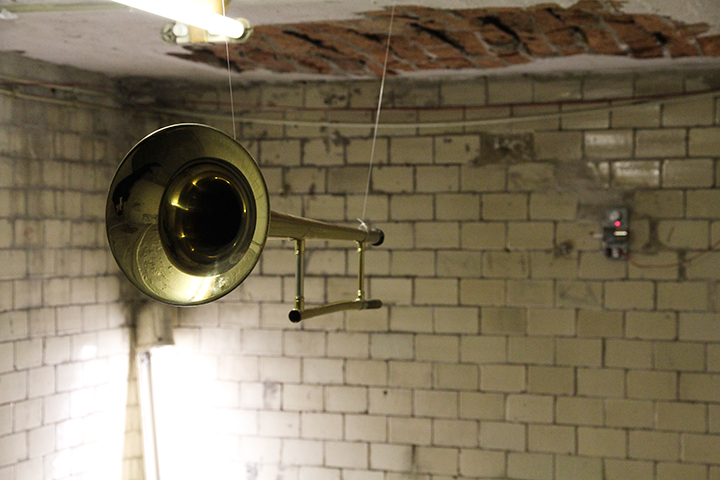
Connector
Connector, a sound installtion work implies a sonic interaction between instruments/sound objects that are connected to mechanical devices by nylon lines, both of which were previously presented in the form of a live performance. The same instruments /sound objects are now able to produce sounds autonomously, independent of a performer. The Connector reflects one of my main concerns as a composer, which is to challenge the function of the traditional musical instruments by displacing them in "non-musical" contexts.
Materials: 2 motors, trombone bell, 2 violins, drum head, tube, nylon line, devices,silicon rubber
Size: Variable
Edition: Unique
DAS Weekend Transmediale/Stattbad Wedding, Berlin.
Year: 2011
Schablone
The creation of new instruments requires the development of new types of notation. In this way, Papalexandri has developed a specific graphic notation for Untitled II presented in the form of a written score and a clear acrylic glass template. The template here acts both as a tool to write scores as well as a sculptural object.
Materials: acrylic glass, paper,
Edition: Unique (patent protected)
Size: Variable
Gallerie Mario Mazzoli, Berlin.
Year: 2011
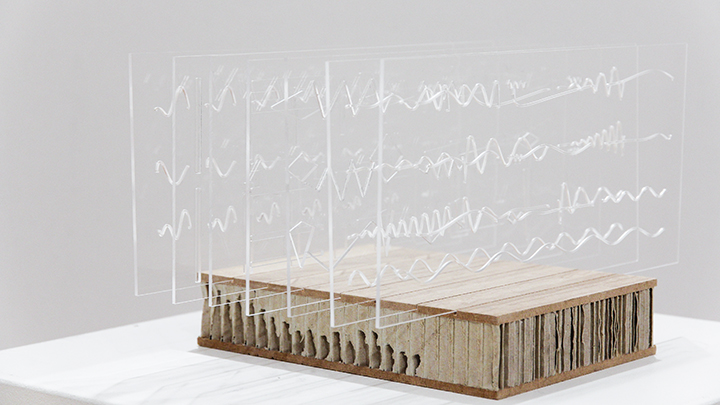
Untitled II
Untitled II builds on modified membraphones developed by Marianthi Paplexandri-Alexandri as main instruments utilizing Pe Lang's motor-activated devices. The sound of Untitled II can be influenced by manipulating the tension of the nylon lines, changing the speed of the motor, turning on and off the motors or by depressing the membrane with the fingers while it is vibrating to vary the pitch. The work creates and explores a soundscape of machine-produced long sustained sounds and textures with organic character and without any post processing. It is a work adaptable to any space that can be presented both as a sounding sculpture and as an instrument in the context of a solo live performance, thereby questioning the role of the performer and the difference between performing and operating ( "music as art" and "music as music").
Materials: three motors, three acrylic glass robs, nylon line, elastic silicone membrane, seventeen acrylic cylindrical tubes
Size: Variable
Edition: Unique
Gallerie Mario Mazzoli, Berlin.
Premiered by Pe Lang at Process Festival, Ausland, Berlin.
Year: 2010
VIDEO (excerpt) | AUDIO 1 | AUDIO 2
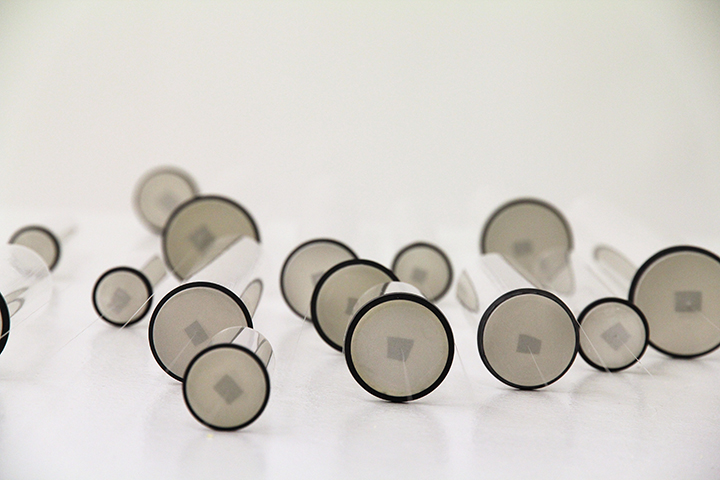
Operator
Operator, for nine instrumentalists,combines acoustic instruments, preparations, new self-constructed motor-driven instruments and sound devices, which function as the main sound sources. Operator questions the role of the performer in the music and the dramatic arts by investigating differences between playing, operating and performing.Furthermore it expands on the idea of using motor-driven sound props that function both as sound sources and as active preparations determining the speed, dynamics and other musical parameters. This process encourages the performer to listen proactively and become aware of the possibilities latent between him or her and the instrument.This interaction between the performer and the instrument is particularly challenged with new instrumental-sound devices and preparations developed in collaboration with artist PeLang.
Commissioned by Ensemble Mosaik. Premiered at the Dialoge Festival in Salzbourg. Instruments: Oboe, Bass flute, Bass Clarinet, Bass Saxophone, Piano, Percussion, Violin, Viola and Cello. Sound/mechanical devices: Silicone, Wheel, Bow, prepared acrylic glass tube, vibration motor and vibration mallets(patent protected). Materials: Kappa, acrylic glass cylinder and ipod.
Year: 2010
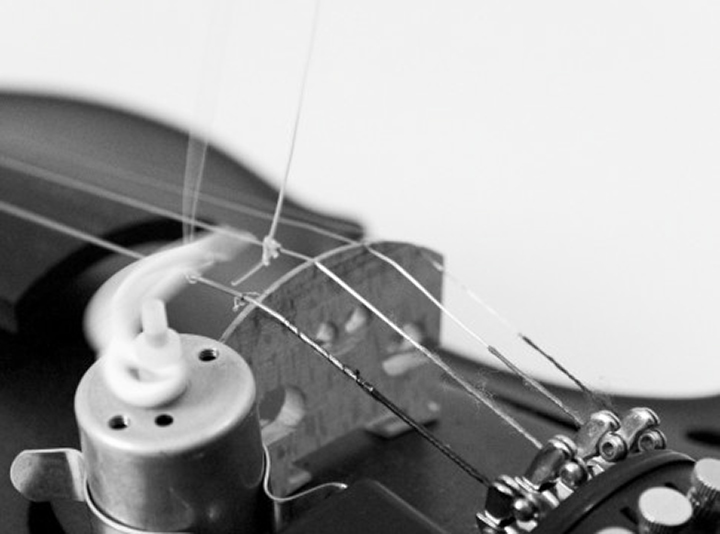
Untitled
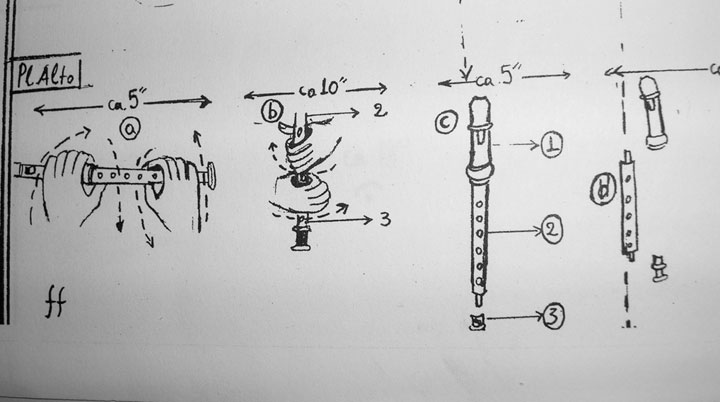
Untitled is using prepared acoustic instruments (bass flute, alto and soprano flute head joint) and mechanised sound devices made in collaboration with artist Pe Lang, which function both as preparations and as independent musical instruments. With these, I explore new bodily movements and sounds by building mechanisms which mandate and manifest different approaches to musical interpretation.
Commissioned by Electronic Music Studio (EMS) Stockholm.
Premiered by Erik Drescher, COMA Gallery Centre for Opinions in Music and the Arts, Berlin, Germany.
Year: 2009
VIDEO | AUDIO (available soon)
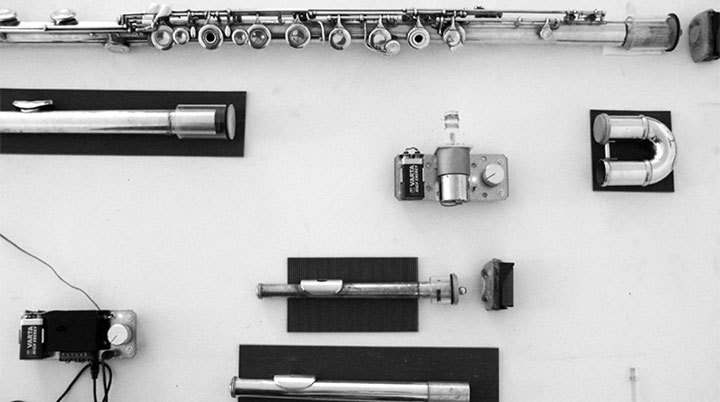
Reciprocal
A large part of my work is formed through the manipulation of conventional instruments by preparations. In manipulating the instrument, I constrain habitual actions to force more immediate reactions in the performer. There reactions, in turn, allow new forms of behavior and communication in the ensemble. In addition to the preparations, l combine new instruments-machines and devices which function both as preparations and as independent instruments. Reciprocal, for 11 instrumentalists continues to expand on these ideas by using preparations and devices that allow to form a continuous sound as the principal sound sources.
Instuments: flute, contra bass clarinet, accordion, piano, drop machine, trombone, violin 1, violin 2, viola, cello and bouble bass.
Commissioned by Klangforum Wien and the International Ensemble Academy of Graz.
Premiered by Klangforum Wien, Impuls Prize Concert at Helmut-List-Hall, Graz. Conducted by Enno Poppe.
Preparations designed by Marianthi Papalexandri-Alexandri. Sound devices and machines made by Pe Lang.
Year: 2009
Warten
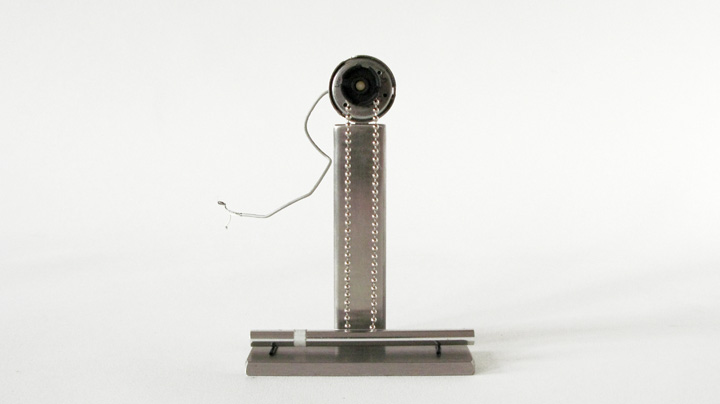
Warten was developed in collaboraion with Pe Lang. The work explores slow, minimal physical movements and machine-produced long sustained organic sounds and textures. Warten was premiered at the Wien Modern Festival by percussionist Matthew Jenkins.
Materials: drop machine, bead chains, table, chimes, small pieces of wood, thin metal, paper, violin mutes.
Instruments: drop machine by Pe Lang. Drop machine: DC-motor, bead chain loop, metal bracket, amplification materials (2007).
Year: 2008
Yarn
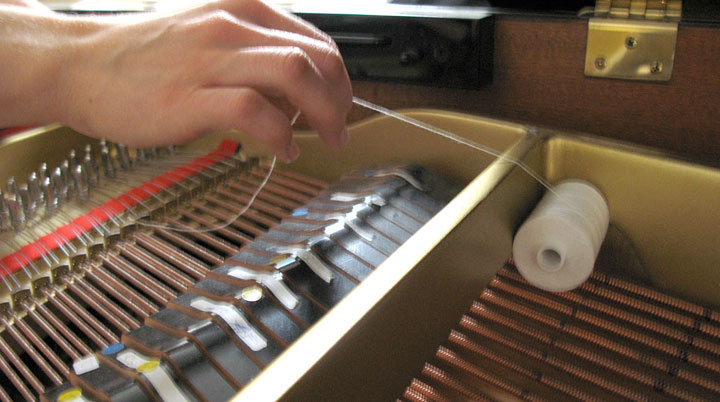
Yarn explores alternative possibilities of playing conventional musical instruments. In this piece, two string instruments are connected by a fishing line tied to a string on each instrument. This connector string is bowed to transmit sound between the two connected instruments which now become a single percussive instrument. For this piece, the percussionist (bowing the central string) and the two string players have to coordinate their bodily gestures in order to achieve the ideal sound. The fragile equilibrium born out of this compound instrument necessitates a heightened sensitivity among the performers and a very particular form of listening and bodily reaction.
Commissioned by the Internationale Musikinstitut Darmstadt for the Kranichstein Prize.
Premiered by E. Birynkova (fl), M. Walentynowitz (pno), S.Ota (vln), S. Ahrendt (vln), P. Miller (vla), M. Nishioka (prc) and E. Borgir (vlc).
Preparations designed by Marianthi Papalexandri-Alexandri
Year: 2008.
Kein Thema
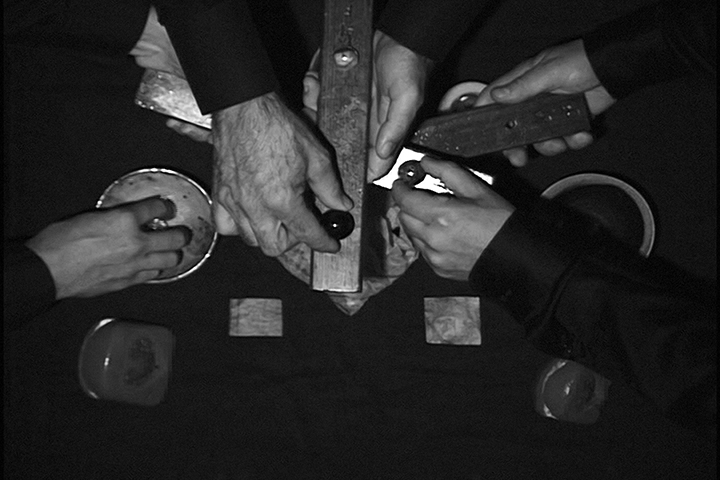
Kein Thema focuses on alerting the habitual perceptions of the performer. In manipulating the instrument, I constrain habitual actions to provoke more immediate reactions in the performer. These reactions, in turn, allow new forms of behavior and communication in the ensemble. Kein Thema also aims to expand various micro movements in the preparation and the act of producing sounds that are acoustically and visually perceptive from a closer distance. Furthermore, it reflects my intention to explore how limitation can lead to new possibilities in sound. In this way the piece explores a very small number of gestures, actions and instruments. The idea is to examine the same repetitive physical gestures under different conditions.
Commissioned by Steven Schick for the Roots and Rhizomes: Seventy-Five Years of Percussion Music Conference.
Premiered by Steven Schick, Ross Karre and Justin De Hart.
Year: 2007
Kita
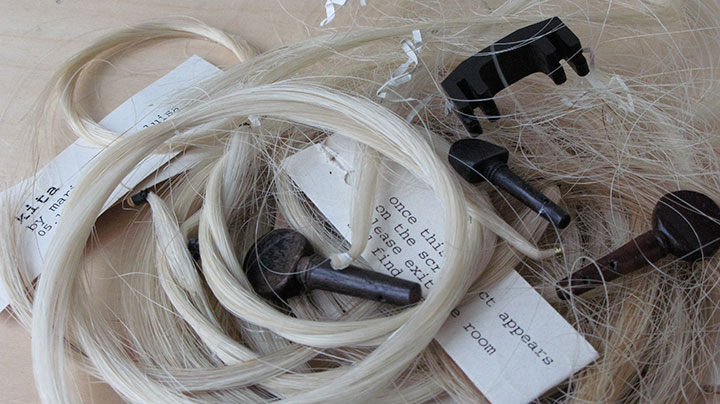
Kita is an interactive, sonic-visual piece that analyzes the role of the performer and audience in contemporary music. Kita means look in Greek. In this context, the video operates both as a self-reflexive and compositional tool that facilitates extending the physical limits and possibilities of the performing body. Operating like a still life, the video’s literal frame perceives the micro details of both the movements and the sounds generated by performers. Finally, it provides the possibility of exposing the detailed movements and gestures that one cannot experience through a musical score and of making the sounds that come along with the detailed movements audible and traceable.
Kita was developed in collaboration with visual artist Luisa Greenfield and it was premiered at the Etcetera New Music Festival, San Diego.
Year: 2007
VIDEO | AUDIO
Models
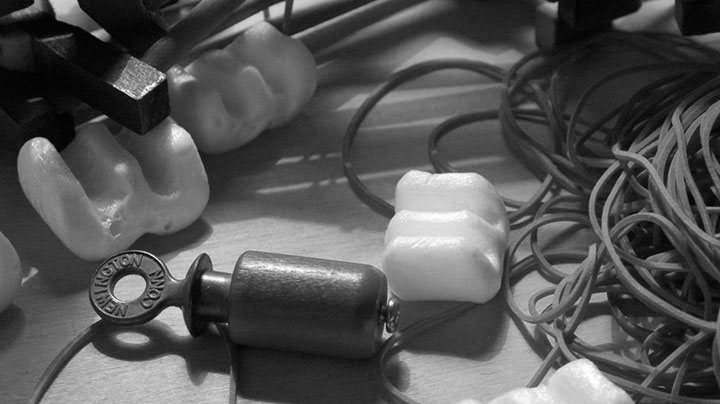
Models for prepared bass flute mouthpiece, violin, piano and objects (styrofoam, plastic fork, rubber band, music stand and bird call). This work
reflects my intention to create an intimate visual-audio experience where materials can change place without losing their individuality, creating the possibility of sounding again under different conditions.
Commissioned by Gascia Ouzounian for Ensemble Bye Bye Butterfly: Gascia Ozounian (vln), Kathleen Gallagher (fl), Aiyun Huang (prc), and Katalin Lucaks (pno). World premiere: The University of California, Art Gallery, San Diego.
Year: 2006
VIDEO | AUDIO
b as i eye us be
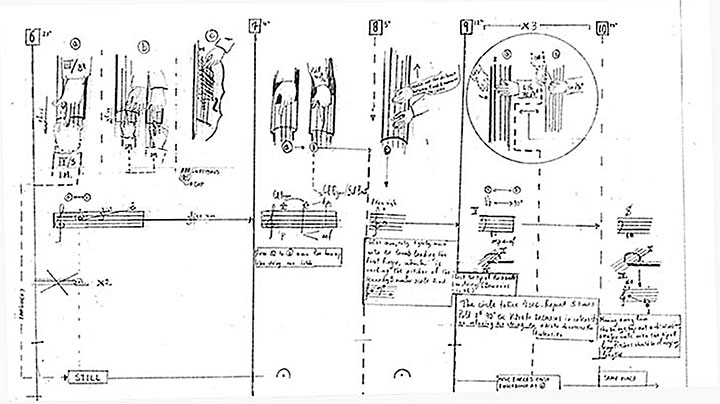
b as I eye us be, a piece for one instrument and two performers. The instrument is a double bass. Performer 1 is a real bassist-pianist while performer 2 is an imaginary bassist. Both players use the same instrument. The score consist of two lines, one for each performer. The real performer coordinates movement and sound according to both parts. b as I eye us be examines under what conditions the performer’s way of thinking and playing might change. Particularly, how the presence of the imaginary performer will make the performer to think in a similar way a conductor thinks and imagines a whole orchestra while studying the score. In this piece the imaginary performer will never appear on stage. He or she exists only in the real performer’s mind. However, the real performer has to follow and resituate body and mind according to the imaginary performer. Although these points might be perceived as silence by the audience (at least by the unsuspected audience) they are not silence for the real performer. Even if there’s no one else there, the real performer is giving his/her space to someone else.
Premiered by Scott Waltson, Warren studio A, University of California, San Diego.
Year: 2005
VIDEO | AUDIO
No Name
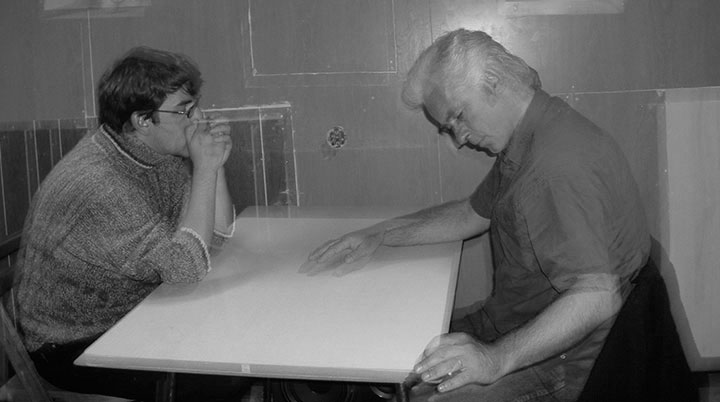
No Name is a sound-visual installation-live performance for magnetic tape and two musicians without instruments. It's a work for a trombonist and a pianist sitting on opposite sides of a table, exploring the musical, theatrical, dance-like character of different bodily movements (physical actions).
Commissioned by Orkest de Volharding. Premiered by Koen Kaptjin and Jaap Dercksen, MS Blommendal, Docklands, Amsterdam, Holland.
Year: 2004
VIDEO | AUDIO (available soon)
Still Life
Still Life for recorder quartet reflects my approach to all musical instruments, which consists of modifying the image of an instrument by making it produce sounds that would not normally be associated with it. In this context, 'modifying' refers to a deformation and deconstruction of the conventional use of the instrument, in order to produce innovative and meaningful formal principles and to explore a new quality of sounds as an expansion of the power of noises. The piece also reflects my intension to invent new sound sources of sounds deriving from the use of unusual activities (dramatic elements) and reuse of pre-existed ones on stage. The work projects repetitive bodily gestures that produce mechanical like sounds that derive both from the instrument and the body.
Still Life was written for Ensemble QNG and was commissioned by Kulturfeste im Land Brandenburg.
Premiered by QNG (Susanne Fröhlich, Andrea Guttmann, Hannah Pape and Heide Schwarz) at the Kulturfeste im Land Brandenburg-Music fur Ravensbrück Festival, Ravensbrück, Germany. Audio recording: CD: QNG etheral.
Audio recording: CD: QNG etheral.
Year: 2003
VIDEO | AUDIO
N 45 immense
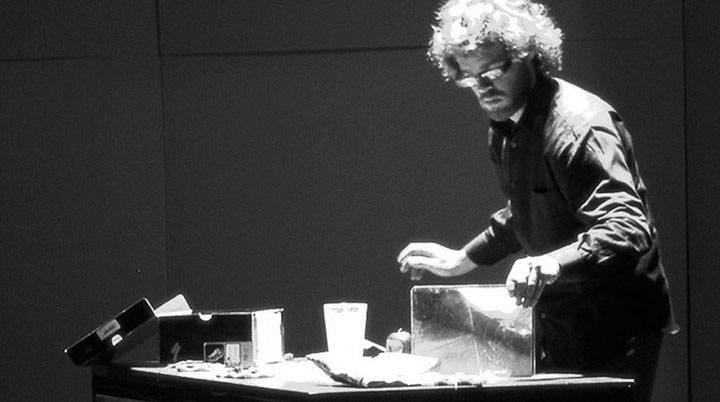
When does an instrument become an ‘object’? Do we treat instruments differently then objects? If so, why? At the end of the piece, No 45 immense, the percussionist picks up a fizzy vitamin C tablet (hidden inside the box), which he drops into a glass of water. He pauses, and waits for it to dissolve completely. The absence of action and sound here is what I call an ‘energetic silence’. The performer is not trying to become invisible. He is not acting. On the contrary, his body language maintains energy and tension. The action is now taking place inside the water. One can argue who is the performer- the person, the tablet or the water?
N 45 immense solo for objects: red apple, newspaper, magnifying glass, water, zip, plastic glass of water, sand blocks, coins, small bells, shoe box, bass guitar string, espresso plate, clear transparent plastic pen, wooden table and fizzy vitamin C tablet.
Commissioned by Stockholm International Composition Course (SICC). Premiered by Niklas Brommare, Spelplan Festival, Kulturhuset, Stockholm.
Audio recording: performance by percussionist Matthew Jenkins (November 2006).
Year: 2002
VIDEO | AUDIO
gaze
gaze explores the idea to generate a piece using a small number of elements through the expansion of those elements into different textures by the use of unconventional instrumental techniques, preparation and repetition. Preparation aims to create abnormal tone qualities and to alter or distort the texture of sound (pitch and timbre), through the addition and friction of external factors (such as paper, plastic wrap, foil, fabric, etc.) with strings and surfaces (tone holes mouthpieces) in order to produce an unconventional sound pattern. At the same time, preparation introduces structural and functional possibilities by defining musical sections and affecting the form of playing. Finally, it adds a theatrical and dramatic dimension, whereby the visual contributes to the experience, while the sound remains the principal key element in the composition.
Commissioned by Tom Pauwels, for the X Festival of Contemporanea of Music Chilenea. Premiered by The Black Jackets Company Ensemble:
David Nuñez (violin), Tom Pauwels(acoustic guitar), Benjamin Dieltjens (clarinet) and Kim Vandembrempt (piano). Conductor: Juan Carlos Tolosa.
Year 2000
VIDEO | AUDIO

© Marianthi Papalexandri-Alexandri